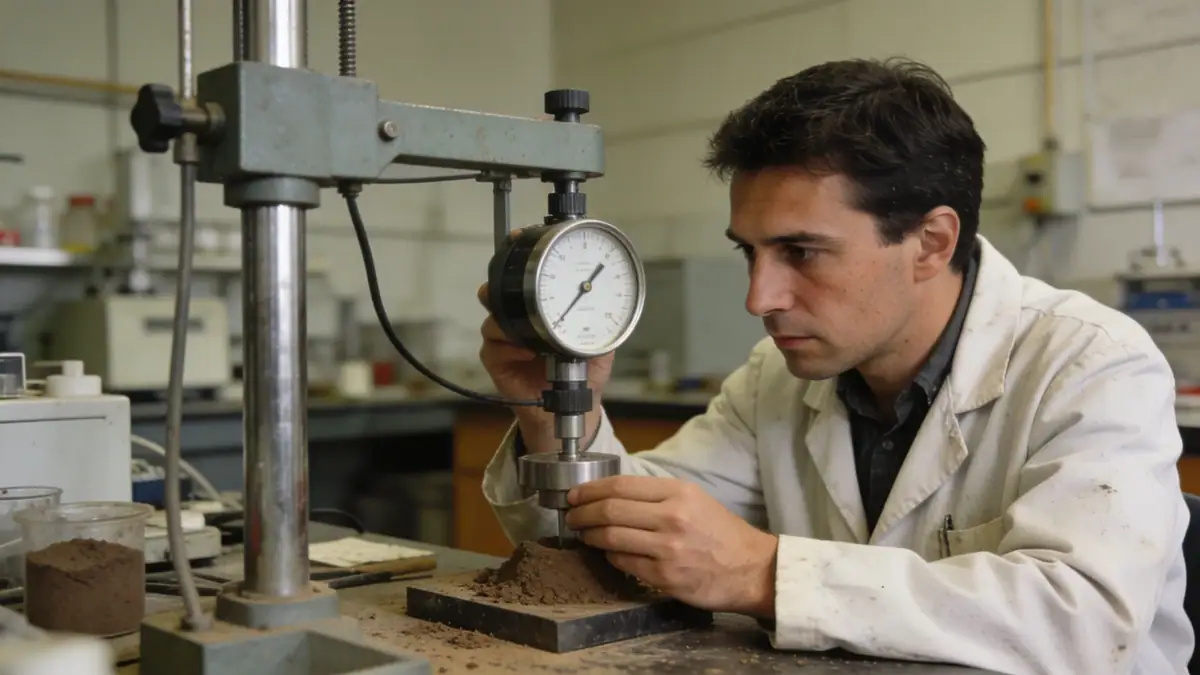
Methodology
Our methodology for standard penetration test in Montreal follows ASTM D1586, with a safety hammer and automatic trip system to ensure consistent energy delivery. We recommend borehole spacing of 30 to 50 meters for residential projects and 15 to 30 meters for critical infrastructure. Sampling intervals are typically 1.5 meters, with continuous sampling in soft sensitive clays. For deeper investigations, we integrate cone penetration test (cpt) to obtain continuous stratigraphic profiles. Our team calibrates equipment daily and documents all field procedures to maintain data integrity.
Reference Technical Parameters
| Parameter | Reference Value |
|---|---|
| Predominant soil type | Champlain Sea clay, glacial till, sand |
| Maximum seismic acceleration (PGA) | 0.4g (per NBCC 2020) |
| Typical groundwater level | 1.5 to 5 m below surface |
| Bedrock depth | 5 to 30 m (variable) |
| Typical N60 range | 2 to 50 blows/0.3 m |
Local Considerations — Montreal
Montreal's subsurface is dominated by Champlain Sea clay, a sensitive marine deposit prone to strength loss under seismic loading. The St. Lawrence Lowlands region has moderate seismicity (PGA up to 0.4g), requiring site-specific response analysis per NBCC 2020. Groundwater levels are shallow (1.5–5 m), influencing excavation dewatering and foundation design. In older boroughs like Plateau-Mont-Royal, fill and organic soils complicate SPT interpretation, while in Westmount, competent bedrock at shallow depth favors spread footings. Our team has extensive experience in these conditions, and often deploys dpsh dynamic probing to rapidly assess soil variability across large sites.
Request a Quote
Our team reviews your project and issues an initial report at no cost.
Or write us directly at [email protected]
Services in Montreal
Locations covered in Montreal
Applicable Standards
- ASTM D1586
- NBCC 2020 Seismic Provisions
- CSA A23.3
- Quebec Construction Code (Chapter I, Building)
Frequently Asked Questions
What soil types are most common in Montreal for SPT investigations?
Montreal's soils are predominantly Champlain Sea clay (sensitive, low strength), glacial till (dense, variable), and sand/gravel deposits. SPT N-values in clay can be as low as 2 blows/0.3 m, while till may exceed 50 blows. Understanding this variability is critical for foundation design.
How does seismic zoning affect SPT requirements in Montreal?
Montreal is in seismic zone 2 (NBCC 2020), with PGA up to 0.4g. SPT data is essential for evaluating liquefaction potential in sandy layers and determining site class (A–F). For sensitive clays, SPT alone may be supplemented with CPT and shear wave velocity measurements.
Is a standard penetration test mandatory for all construction projects in Montreal?
The Quebec Construction Code mandates geotechnical investigations for most buildings. SPT is the standard method for soil strength and stratification, though alternative methods like CPT or dynamic probing may be accepted for certain conditions. Always consult local regulations.