Methodology
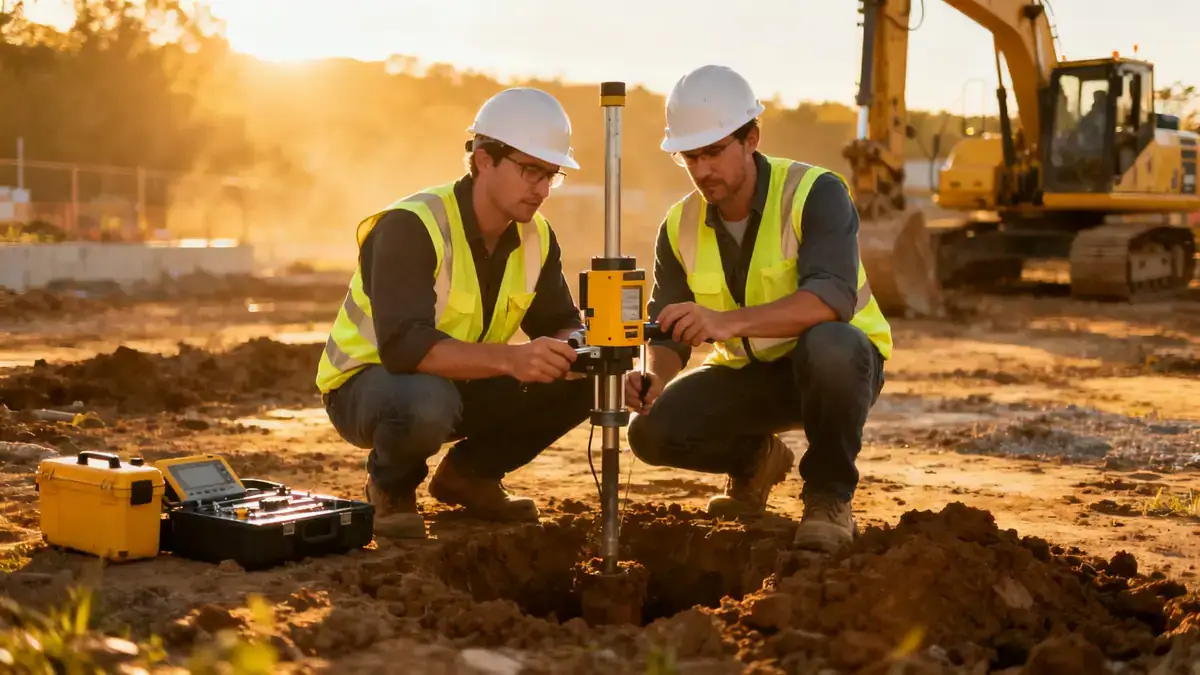
DPL Light Dynamic Probing follows the procedure outlined in Eurocode 7 and ASTM D1586 guidelines adapted for light equipment. Our team uses a 10 kg hammer with a 0.5 m drop height, driving a 60° cone (tip area 10 cm²) into the ground. Blow counts (Nd) are recorded every 0.1 m to a maximum depth of 8 m, depending on soil resistance. The test is performed in accordance with the Canadian Foundation Engineering Manual and local regulations. We correlate DPL results with other in-situ tests like Cone Penetration Test (CPT) for comprehensive site characterization. Data is processed using proprietary software to estimate soil density and bearing capacity.
Reference Technical Parameters
| Parameter | Reference Value |
|---|---|
| Hammer weight | 10 kg |
| Drop height | 0.5 m |
| Cone tip area | 10 cm² |
| Maximum depth | 8 m (typical) |
| Blow count recording interval | 0.1 m |
Local Considerations — Canada
Canada's diverse geology—from glacial tills in Toronto to marine clays in Vancouver—requires adaptable DPL deployment. In cities like Abbotsford and Airdrie, alluvial soils necessitate shallow probing for foundation design. Our team adjusts testing protocols based on local conditions, referencing regional seismic zones and frost depths. For example, in Barrie, DPL is used to assess compaction of granular fills. We maintain equipment calibrated to national standards, ensuring reliable data across all provinces. Our hub in Toronto coordinates logistics for rapid mobilization to sites in Belleville, Brampton, and beyond.
Request a Quote
Our team reviews your project and issues an initial report at no cost.
Or write us directly at [email protected]
Applicable Standards
- ASTM D1586 - Standard Test Method for Standard Penetration Test (SPT) and Split-Barrel Sampling of Soils
- Eurocode 7 - Geotechnical Design – Part 2: Ground Investigation and Testing
- Canadian Foundation Engineering Manual (CFEM) - 4th Edition
- ISO 22476-2:2005 - Geotechnical investigation and testing – Field testing – Part 2: Dynamic probing
Frequently Asked Questions
What is the typical depth range for DPL Light Dynamic Probing?
The DPL test typically reaches depths of 2 to 8 meters, depending on soil resistance and equipment configuration. In very dense soils or gravels, refusal may occur earlier. Our team assesses site conditions to determine the appropriate depth for each project.
How does DPL compare to Standard Penetration Test (SPT)?
DPL uses a lighter hammer (10 kg vs 63.5 kg for SPT) and records blow counts per 0.1 m instead of per 0.3 m. It is more suitable for shallow, low-strength soils and rapid profiling. SPT provides soil samples and is preferred for deeper investigations. Both tests can be correlated for comprehensive analysis.
What standards govern DPL testing in Canada?
DPL testing in Canada follows Eurocode 7 and ASTM D1586 guidelines, adapted to local practice. The Canadian Foundation Engineering Manual provides recommendations for interpretation. Our laboratory ensures compliance with these standards and maintains calibration certificates for all equipment.
How much does DPL Light Dynamic Probing cost in Canada?
The cost for DPL testing ranges from $1,430 to $5,720 per project, depending on depth, accessibility, number of test points, and mobilization distance. This range reflects 2026 rates for typical urban projects. For an accurate quote, please contact us with your site details.