Methodology
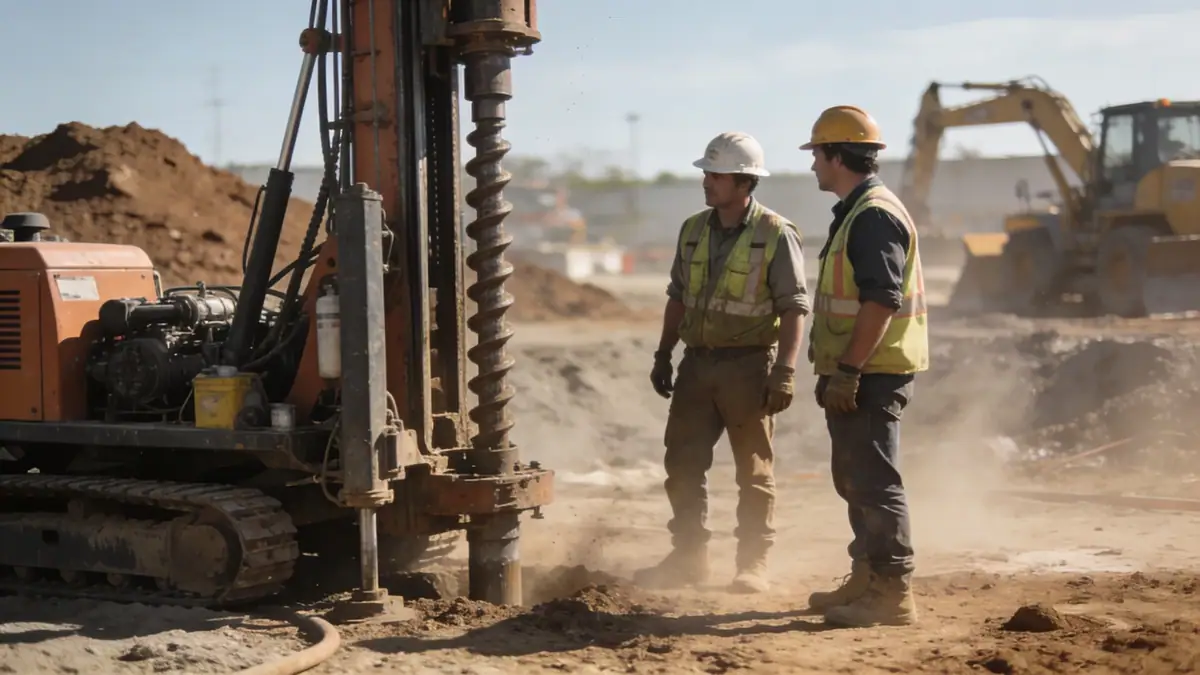
The DPSH dynamic probing procedure follows the principles outlined in the Canadian Foundation Engineering Manual (CFEM) and references international standards such as ASTM D1586 for energy calibration. Our team uses a 63.5 kg hammer with a 750 mm drop height, driving a 50 mm diameter cone tip. The number of blows per 100 mm penetration (N10) is recorded continuously to a depth of up to 15 m, depending on ground conditions. Energy efficiency is monitored using a load cell to ensure consistency, with measurements typically ranging between 55% and 70% of theoretical energy. The data are processed in real time to produce continuous resistance logs, which are then correlated with adjacent boreholes for stratigraphic interpretation. All equipment is calibrated annually, and field procedures adhere to the quality management system of our firm.
Reference Technical Parameters
| Parameter | Reference Value |
|---|---|
| Hammer Mass | 63.5 kg |
| Drop Height | 750 mm |
| Cone Diameter | 50 mm |
| Penetration Depth | Up to 15 m (variable with soil density) |
| Recording Interval | Blow count per 100 mm (N10) |
Local Considerations — Canada
Canada’s varied geotechnical landscape—from the soft marine clays of the St. Lawrence Lowlands to the glacial tills of the Prairies—requires adaptable probing strategies. In cities like Vancouver and Burnaby, where deep alluvial deposits overlay bedrock, DPSH probing helps delineate soil layering for seismic design under the National Building Code of Canada. In Calgary and Edmonton, the presence of high-plasticity clays and occasional cobbles demands robust driving assemblies and careful refusal criteria. Our firm tailors the probing depth and energy monitoring to local conditions, ensuring reliable data for foundation design in each region. This national presence allows consistent methodologies across projects from Abbotsford to Toronto.
Request a Quote
Our team reviews your project and issues an initial report at no cost.
Or write us directly at [email protected]
Applicable Standards
- Canadian Foundation Engineering Manual (CFEM) 5th Edition
- ASTM D1586 – Standard Test Method for Standard Penetration Test (SPT) and Split-Barrel Sampling of Soils
- National Building Code of Canada (NBCC) 2020 – Seismic Provisions
- ISO 22476-2: Geotechnical Investigation and Testing – Field Testing – Part 2: Dynamic Probing
Frequently Asked Questions
What is the difference between DPSH and SPT?
DPSH uses a continuous recording of blow counts per 100 mm penetration, while SPT records blow counts over a 300 mm interval after a seating drive. DPSH provides a higher-resolution profile and is often used for preliminary stratigraphic assessment or in soils where SPT sampling is difficult.
What are the typical refusal criteria for DPSH?
Refusal is typically defined as 50 blows per 100 mm penetration or when the driving assembly rebounds more than 5 mm per blow. In dense soils or at depths approaching the maximum capacity of the equipment, the test is stopped to avoid damage to the cone or rods.
How is DPSH data correlated with SPT?
Empirical correlations between DPSH N10 and SPT N60 are established based on local soil conditions. For example, in granular soils, N60 ≈ 0.8 × N10, but site-specific calibration is recommended. Our team uses parallel testing at selected depths to develop reliable site-specific correlations.
How much does DPSH Dynamic Probing cost in Canada?
The cost for DPSH Dynamic Probing typically ranges from $1,720 to $5,720 per project, depending on the number of test points, depth of penetration, site accessibility, and mobilization distance. This range is a 2026 reference estimate; we recommend contacting our team for a detailed quotation based on your specific requirements.