Methodology

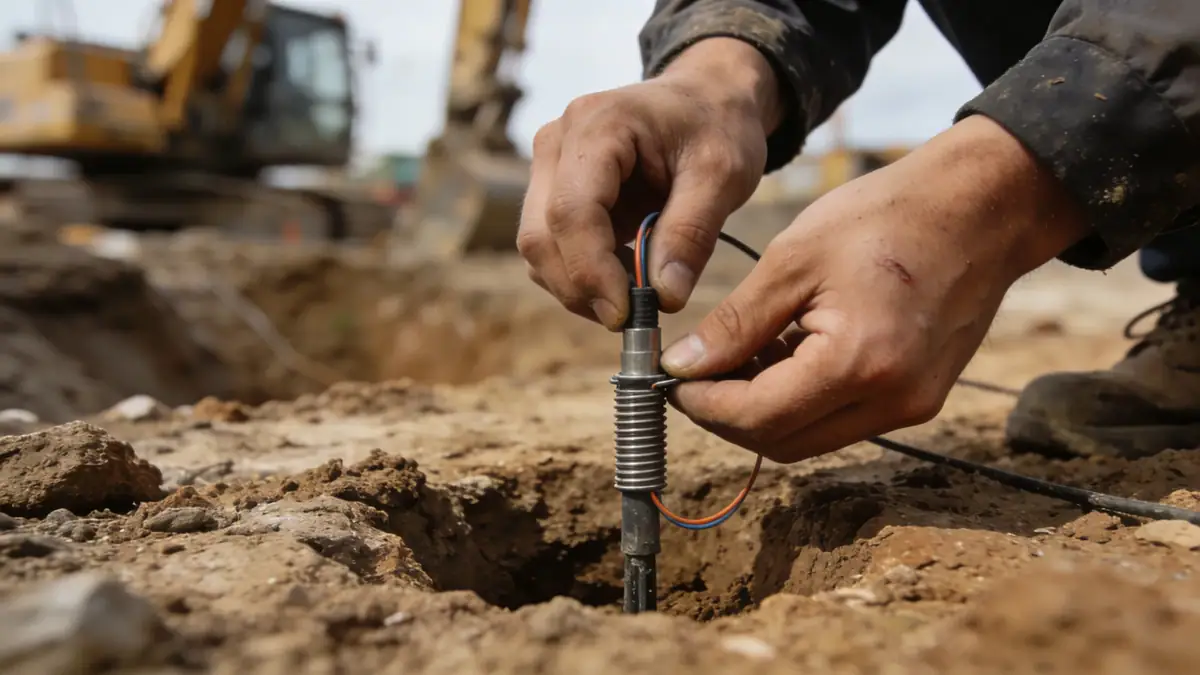
Our methodology for the standard penetration test in Kamloops follows ASTM D1586, employing a 63.5 kg hammer with a 0.76 m drop to drive a split-spoon sampler. We record blow counts per 0.15 m interval, reporting N60 values corrected for hammer energy efficiency. Boreholes are advanced using hollow-stem augers to minimize disturbance, with sampling intervals typically at 1.5 m depths or at every change in stratum. For seismic projects, we integrate SPT with shear wave velocity measurements to evaluate liquefaction potential under NBCC 2020 seismic loads. Our field procedures are complemented by rigorous quality control, including hammer energy calibration and torque checks, ensuring repeatable and defensible data for foundation design in Kamloops.
Reference Technical Parameters
| Parameter | Reference Value |
|---|---|
| Predominant soil type | Glacial till and fluvial sands |
| Maximum seismic acceleration (PGA) | 0.26g (NBCC 2020) |
| Typical groundwater level | 3–8 m below grade |
| Bedrock depth | 10–30 m (bedrock: volcanic and sedimentary) |
| Typical N60 range | 10–50 blows/0.3 m |
Local Considerations — Kamloops
Kamloops' geology is dominated by glacial till, glaciofluvial sands, and gravels overlying Tertiary volcanic and sedimentary bedrock. The region is seismically active, with design PGA of 0.26g per NBCC 2020, requiring careful liquefaction assessment in saturated sands near the Thompson River. Groundwater levels vary seasonally, typically 3–8 m deep, but can rise after snowmelt. Local variations exist between the Valleyview silty clays and the Aberdeen sandy deposits. Our team has extensive experience in this setting, and we coordinate with our standard penetration test en Vancouver hub for regional projects. For deep foundations, we recommend complementary cone penetration test (cpt) to obtain continuous stratigraphic profiles.
Request a Quote
Our team reviews your project and issues an initial report at no cost.
Or write us directly at [email protected]
Services in Kamloops
Applicable Standards
- ASTM D1586
- NBCC 2020 (National Building Code of Canada)
- BCBC 2018 (British Columbia Building Code)
- CSA A23.3 (Concrete Design)
Frequently Asked Questions
What soil types are typically encountered in Kamloops during SPT?
Kamloops soils are primarily glacial till, glaciofluvial sands, and gravels, with localized silty clay deposits in valley bottoms. These materials exhibit variable density and stiffness, making the standard penetration test essential for characterizing bearing capacity and liquefaction resistance.
Is seismic site classification required for projects in Kamloops?
Yes, under NBCC 2020, seismic site classification (Site Class A–F) is mandatory for most buildings. The standard penetration test provides N60 values used to determine Site Class D or E, directly influencing base shear calculations and foundation design.
Are geotechnical investigations mandatory for residential construction in Kamloops?
While not always required for single-family homes, the City of Kamloops recommends subsurface investigations for any structure with deep foundations or in areas of known liquefaction susceptibility. Many lenders and insurers now require SPT-based reports for new developments.